Friday, December 10, 2004
Leg 2 Day 13 : 59' 07S 81' 10W
Our fortunes have been somewhat mixed over the last few hours it has to be said. There is water water everywhere and not a lot to drink. Well, for the time being - and after hours and hours of struggle from Cop and David wielding manuals and tools - we HAVE just managed to fill all our tanks, but are facing a situation with the water-maker which is far from ideal. And, if it worsens of course, our position could be in jeopardy if forced to divert to pick up water from a passing ship. Due to plankton and algae blocking up the filters, and a weak pump, we have not been able to make much water. This problem is all compounded when it's rough, punching through the waves to windward; the water-maker is far fonder of calm seas for doing its job. The net result is that we are brushing our teeth in sea water, unable to wash and monitoring every drop. 'Fresh water to be used only for drinking and cooking - NOTHING ELSE, signed The Management' reads the notice in the companionway. [Editor's Note: they have got 1700 litres onboard in tanks, including 2 that are sealed that they can open if it breaks down completely, which is designed to be enough to get them to the end of the leg] Not that many of us would be hardy enough to strip off for a shower anyway - we have come all this way to 59 south without any heating below decks whatsoever! Yesterday, I woke up sensing that perhaps three sets of thermals, four socks and a hat was overdoing it a little for bed, and it was explained that the heaters had finally been cajoled into action. For 12 hours, a comforting, steamy fug of baking and tea-making greeted us when we come down off watch into the saloon and headed for our cosy sleeping pits. It might have been at this point that we suddenly realised that the boat does in fact smell, but it was nice to be warm. Now, however, the heaters have broken down again.
When our watch headed for our respective pits just four hours ago, the position reports had been promising, whilst the weather looked worrying. We were lying in a very strong third position with a good lead over those behind us but had, along with the rest of the fleet, sailed into an area of wind sheer sandwiched between low-pressure systems to both north and south. This has considerably shaken up the pecking order and we now lie in a tenuous fourth - which could well worsen by the time that the wonderful dawn that is now breaking has turned to day. VAIO and Me to You have overtaken us and for the time being that must be our goal, to hunt them down and re-claim a place in the top three.
Naomi Cudmore

Thursday, December 9, 2004
Leg 2 Day 12 : 59 07 S 77 49 W
Freezing cold, tired, emotionally drained, sometimes dreading the next sail change because you are so worn out from the last one, sometimes welcoming a chance to warm up a bit.
The only real comfort onboard is your bunk. I am sleeping in thermals, fleece thermals, a thermal liner in my winter sleeping bag and a Gore-Tex bivvy bag. It's quite cosy but you need a rest just getting in! The girls are suffering more than the guys and they are wearing hats and gloves too. There is a heater onboard but it's not working so the only heat comes from the hob when we are boiling the kettle or cooking food.
On deck, winds are howling at up to 40 knots true and averaging 35 knots. The yacht is heeled over at 25 degrees all the time. We are relentlessly slamming into huge waves sending torrents of water down the deck and freezing bullets of spray into the faces of the helms or anyone on the rail who lifts their head from the 'tortoise in it's shell position' for the briefest of moments. We are wearing everything we've got in our Curver boxes on deck but we're still taking it in turns to come below to warm up.
Sail changes on the foredeck can be likened to trying to sew your initials into a parachute while clinging to a cliff face upside down under a freezing waterfall. Sounds bleak? Bloody hell you're not kidding! The secret is not to think how awful this environment is or how long we're going to be here. Laura gets through by thinking in milestones, only so many miles to the next waypoint, only so many miles from there etc. Me? I just try not to think about it at all and sing 80's pop tunes in my head. When I asked the rest of my watch if what I'm writing here was how they felt too, Rob (Robin Phillips) said, "If the fires of Hell went out, this is what it would be like". This is the kind of stuff that our parents said builds character. It' s not all bad, we've got each other and we still laugh, we are not miserable just in a bit of a state of shock. We are living the Challenge Business rough weather video. When I bravely told my mates in the pub of how rough it was going to be I wasn't thinking rough 24 hours a day for five weeks - that 'll learn me.
Our course takes us to the edge of the Artic Peninsular and into the 'screaming 60's' so we may not have seen the worst yet either. On a good note, we cracked open a couple of bottles of bubbly today to celebrate Laura and Graham's engagement and David made a moving speech on the importance of love in the world. "It's at times like these, in places like this, that you realise just how important love is" he said.
We're in third place and leading a pack of six yachts all following a similar course. To the North of us are BG SPIRIT and Spirit of Sark holding first and second place with the rest of the fleet behind them. There is a major incentive to sail the boat fast, the quicker we go the sooner we'll get there.
Oh! And Mum, I'll never complain about your cooking again.
John Bass
Wednesday, December 8, 2004
Leg 2 Day 11 : 58°37'00.0"S 72°10'00.0"W
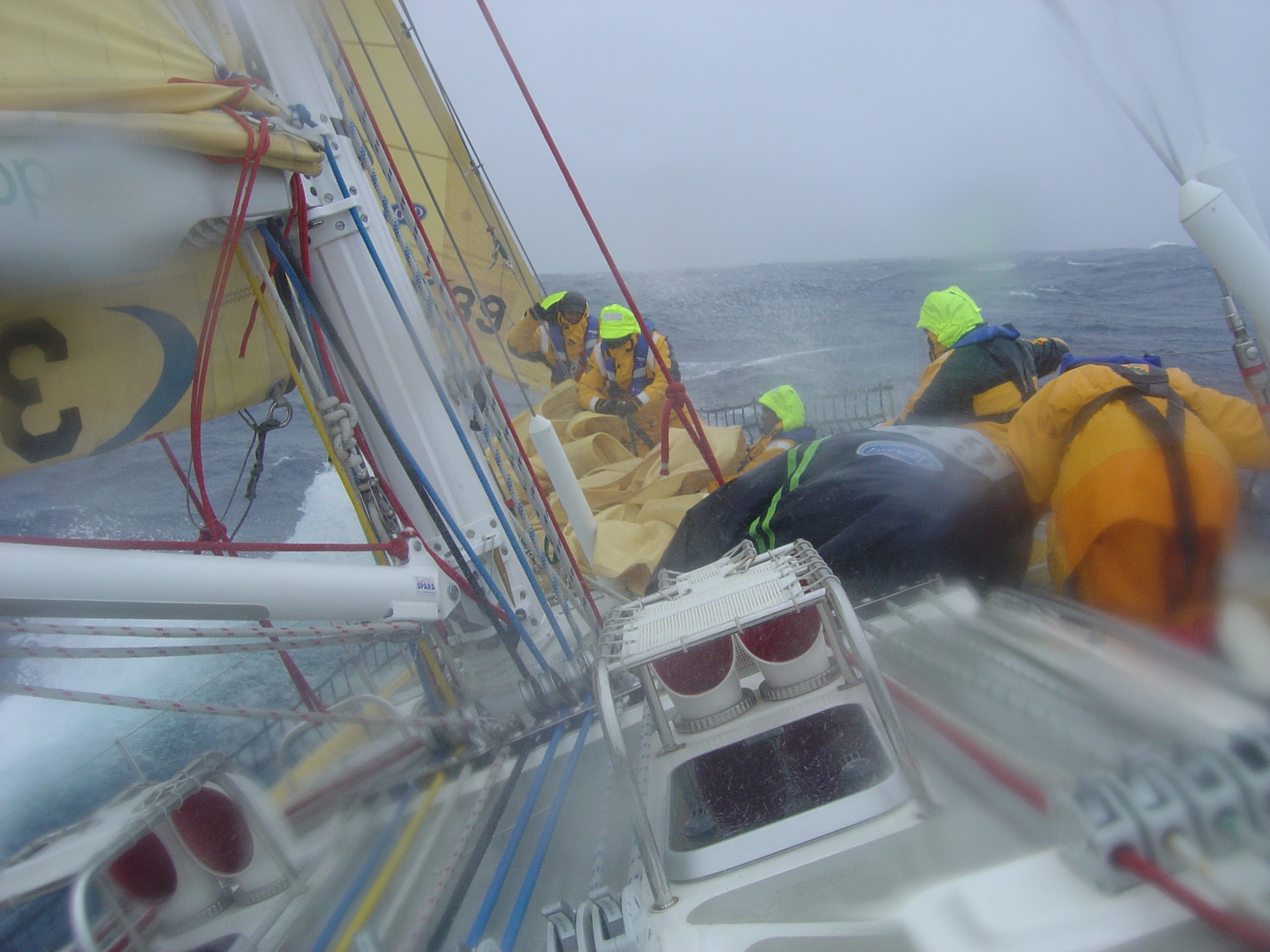
There has been nothing half-hearted about our deep, icy latitude in the last 24 hours - it has been a tough day's run. As watch leader Cop (David Pugh) finally wedges himself against the saloon rail at four in the afternoon to spoon down a long-overdue lunch of risotto (by this point resembling something more like a cold, congealed brick of mushroom googah), the call comes down the companionway - 'up on deck please' - again. It is time for yet another sail change in what has already been a long afternoon. There is a roar of water, those on the rail preparing the No3 yankee are lifted off their backsides by a huge wave and down below the galley comes alive as pots and pans are airborne. Cop's risotto joins the two sails on the floor - a tangle of soaking, and now filthy, spinnaker and yankee sailcloth - none of which has yet been packed away because we simply have not made it down below to bring order to chaos. Getting the No2 down and hoisting the 3 is a fight because the wind has changed so swiftly - six beefy men grit teeth and hang on as they haul the yellow monster onto the deck. It is hard to keep up with the changeable weather. When asked by David how I was finding the Southern Ocean, I replied through chattering teeth, 'exhilarating but cold'.
It is interminably cold - our breath visible in our damp bunks let alone on deck - but at 58 degrees we are almost in the 'screaming sixties' and about as far south as we are likely to get on this leg. Northerly winds are expected later today ahead of a depression, and these should help get us back on the great circle line. Waypoint Alpha is up at a tropical 52 degrees south and is included in the route to keep the fleet north of iceberg territory and the worst of the southern ocean. We are about a quarter of the way to Wellington and a hot shower, and 1,700 miles from Waypoint Alpha. Our wake, meanwhile, is 1,755 miles long! This morning things are a little more shipshape, but the winds have been hooning around our heads all night - dress code: as many clothes as you can find; menu for the day: as much as possible! Life is very, very basic down here. but we ARE having fun - honest!
Naomi Cudmore




Tuesday, December 7, 2004
Leg 2 Day 10 : Cape Horn here we come - eta 10 hours 55°59'43.3"S 67°09'09.5"W
I cannot imagine being in the shoes of heroic Mary Patten when, after putting to sea on her second voyage, her husband, Joshua, collapsed during a storm as they approached Cape Horn in the early autumn of 1856. Captain of the huge clipper ship the Neptune's Car (a three-masted, 200-foot vessel, whose largest sail measured a staggering 70 feet across), Joshua rapidly became too ill to command the ship, and Mary, just 19 years of age and expecting her first child, recognised that the fate of the Neptune's Car, the crew, and her ailing husband lay in her hands.
As luck would have it, thanks to instruction from an enlightened Joshua on her first voyage, Mary was well versed in the art of navigation; she knew how to read the wind and tides, how to calculate the ship's position with sextant and chronometer, how to work out a course to steer and how to record the ship's progress. Drawing on these skills, and earning the loyalty of the anxious crew with an impressive display of oratory delivered from the poop deck, she got on with the job of dealing with everything which the cruel sea (and a mutinous first mate) could throw at her. She finally helmed the vessel into San Francisco Bay on 15 November and was soon besieged by admiring reporters.
In a tragic twist of fate, Mary was to lose her husband just four months after the birth of their son - named after his father - and although she managed to survive the ordeal of the Southern Ocean, it had taken its toll on her health. She died of consumption shortly before her 25th birthday.
It is difficult to overestimate the scale of Mary Patten's achievement. 'Below 40 degrees there is no law, below 50 degrees there is no God' so the saying goes. Cape Horn, the deepest continental point on the planet, lying almost at the bottom of the world in the 'furious fifties' and just 500 miles from Antarctica, certainly sounds like a Godless place!
Here, where the Pacific and the Atlantic oceans meet to do battle in storms that occur on average for 200 days of the year, waves regularly top 65 feet and have been known, on rare occasions, to reach an unimaginable 120 feet.
It is not simply a case of two oceans meeting, however. A multitude of factors combine to lend Drake's Passage - the 400-mile-wide stretch of water between the Horn and Antarctica - its ferocity. The Andes mountains form an effective block, 1,200 miles wide, to the predominantly westerly winds, forcing them south through the gap which is Drake's Passage. And whilst the wind funnelling through this narrow gap gathers pace, to too do the already rapid currents, which are made all the more stormy due to the steep shelving of the sea bed. Francis Chichester makes a useful comparison: 'It is like the sea breaking on the beach at Bournemouth in a gale, except that the waves, instead of being 4 feet high, are likely to be 60 feet high.'
The effect of all of this is that, for the modern sailor, the experience of Cape Horn is often an uncomfortable if momentous occasion. In the great age of sail, however, it was for many a fatal journey - more than 10,000 souls have been lost rounding the Horn.
The significance of the day is not lost on the crew of BP Explorer as we prepare to join the relatively slender ranks of those who have not only had the privilege of rounding the Horn, but of doing it the 'wrong way' - i.e. east to west, against the prevailing winds and currents. Nobody back home need worry too much about our safety - we have our Goretex layers to protect us against consumption and all manner of instruments (not to mention David!) instead of a Mary Patten to get us to where we are going - but think of us as you gather around the fire with the sideways rain on the other side of the window. Out here the albatross are getting bigger by the day and the icy winds are beginning to blow.
-------------------------------------------------------------
The crew of BP Explorer are now offical Cape Horners


As luck would have it, thanks to instruction from an enlightened Joshua on her first voyage, Mary was well versed in the art of navigation; she knew how to read the wind and tides, how to calculate the ship's position with sextant and chronometer, how to work out a course to steer and how to record the ship's progress. Drawing on these skills, and earning the loyalty of the anxious crew with an impressive display of oratory delivered from the poop deck, she got on with the job of dealing with everything which the cruel sea (and a mutinous first mate) could throw at her. She finally helmed the vessel into San Francisco Bay on 15 November and was soon besieged by admiring reporters.
In a tragic twist of fate, Mary was to lose her husband just four months after the birth of their son - named after his father - and although she managed to survive the ordeal of the Southern Ocean, it had taken its toll on her health. She died of consumption shortly before her 25th birthday.
It is difficult to overestimate the scale of Mary Patten's achievement. 'Below 40 degrees there is no law, below 50 degrees there is no God' so the saying goes. Cape Horn, the deepest continental point on the planet, lying almost at the bottom of the world in the 'furious fifties' and just 500 miles from Antarctica, certainly sounds like a Godless place!
Here, where the Pacific and the Atlantic oceans meet to do battle in storms that occur on average for 200 days of the year, waves regularly top 65 feet and have been known, on rare occasions, to reach an unimaginable 120 feet.
It is not simply a case of two oceans meeting, however. A multitude of factors combine to lend Drake's Passage - the 400-mile-wide stretch of water between the Horn and Antarctica - its ferocity. The Andes mountains form an effective block, 1,200 miles wide, to the predominantly westerly winds, forcing them south through the gap which is Drake's Passage. And whilst the wind funnelling through this narrow gap gathers pace, to too do the already rapid currents, which are made all the more stormy due to the steep shelving of the sea bed. Francis Chichester makes a useful comparison: 'It is like the sea breaking on the beach at Bournemouth in a gale, except that the waves, instead of being 4 feet high, are likely to be 60 feet high.'
The effect of all of this is that, for the modern sailor, the experience of Cape Horn is often an uncomfortable if momentous occasion. In the great age of sail, however, it was for many a fatal journey - more than 10,000 souls have been lost rounding the Horn.
The significance of the day is not lost on the crew of BP Explorer as we prepare to join the relatively slender ranks of those who have not only had the privilege of rounding the Horn, but of doing it the 'wrong way' - i.e. east to west, against the prevailing winds and currents. Nobody back home need worry too much about our safety - we have our Goretex layers to protect us against consumption and all manner of instruments (not to mention David!) instead of a Mary Patten to get us to where we are going - but think of us as you gather around the fire with the sideways rain on the other side of the window. Out here the albatross are getting bigger by the day and the icy winds are beginning to blow.
-------------------------------------------------------------
The crew of BP Explorer are now offical Cape Horners


Monday, December 6, 2004
Leg 2 Day 9 : 55°00'00.0"S 65°20'00.0"W
Two hours ago when we came on watch, the Straits de la Maire looked set to become a complete night-mare. Having gone to our beds with Me To You very much within reach and VAIO on the horizon, we emerged from the warmth of our pits to find the enemy all around us! 'Basically the Straights de la Maire have turned into one big parking lot for Challenge yachts,' declared David when I asked him for an update at 0200 local time. 'There are six yachts visible and all the rest are more or less within VHF range. It's a bit of a
headache this windhole, depending on who you are of course.' The tide and the fickle winds have held everyone up. Having arrived in the Straights with the kite flying in a westerly breeze and caught up those in front, we promptly stopped and stuck fast in the frosty seas off Tierra del Fuego
whilst others then caught us in the same way.
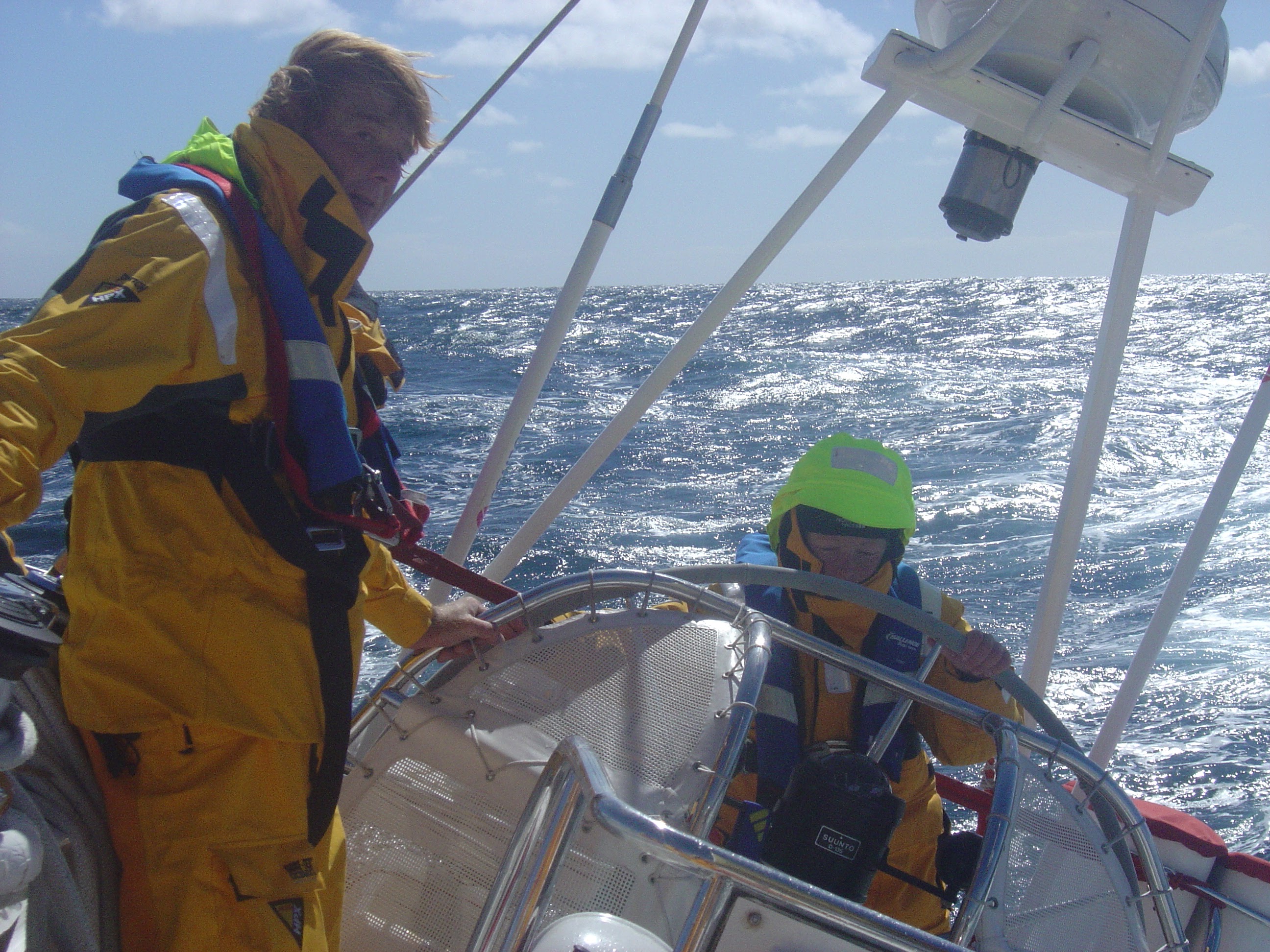
Surrounded by mountains, seals, dolphins and a steel-grey and pink dawn, the air punctuated with seabirds of all kinds, our wonderful surroundings were strangely at odds with our frustration. It seemed ironic to pull in next to the Bay of Great Success, but in fact now it appears that this might be more apt than we previously hoped. Things change so fast. Just a watch ago we were pounding through big seas, fighting to get through the sail changes and reefs with hands which refused to work any more in the penetrating cold. Now, two hours into the new watch, we have a light wind and have narrowly avoided being caught by Team Stelmar (close enough for a chat... no doubt they smelt our early-morning flapjack feast too!), we have overhauled Me To You and are now rapidly hunting down VAIO. 'This is no time for tea! See that light over there,' says the skipper, 'that's third - let's go and get it!'
Naomi Cudmore




Sunday, December 5, 2004
Leg 2 Day 8 : 52°36'00.0"S 63°26'00.0"W
One week in and we know we're approaching the Horn now. The temperature has dropped considerably and the jobs on deck are ten times more difficult. Cold fingers make hanking on a sail painful and thick clothing means just moving around is a bigger drain on energy than normal. In the constantly changing winds we are changing headsails at a rapid pace. As we went on one watch today we changed from a Genoa to hanking on the number one Yankee, to removing it, hoisting the number two, preparing the number three and finally dropping the number two and hoisting the number one in the space of about 40 minutes. The previous watch had been through three different spinnakers before settling with the Genoa. We are about 140 nautical miles from Staten Island where we hope to pass through the Straits de la Maire with the tide and thus keep or better our third place position. Team Stelmar have swapped places with Barclays Adventurer on the horizon and are keeping us on our toes constantly.
Naomi introduced her watch yesterday and I will do the same now:
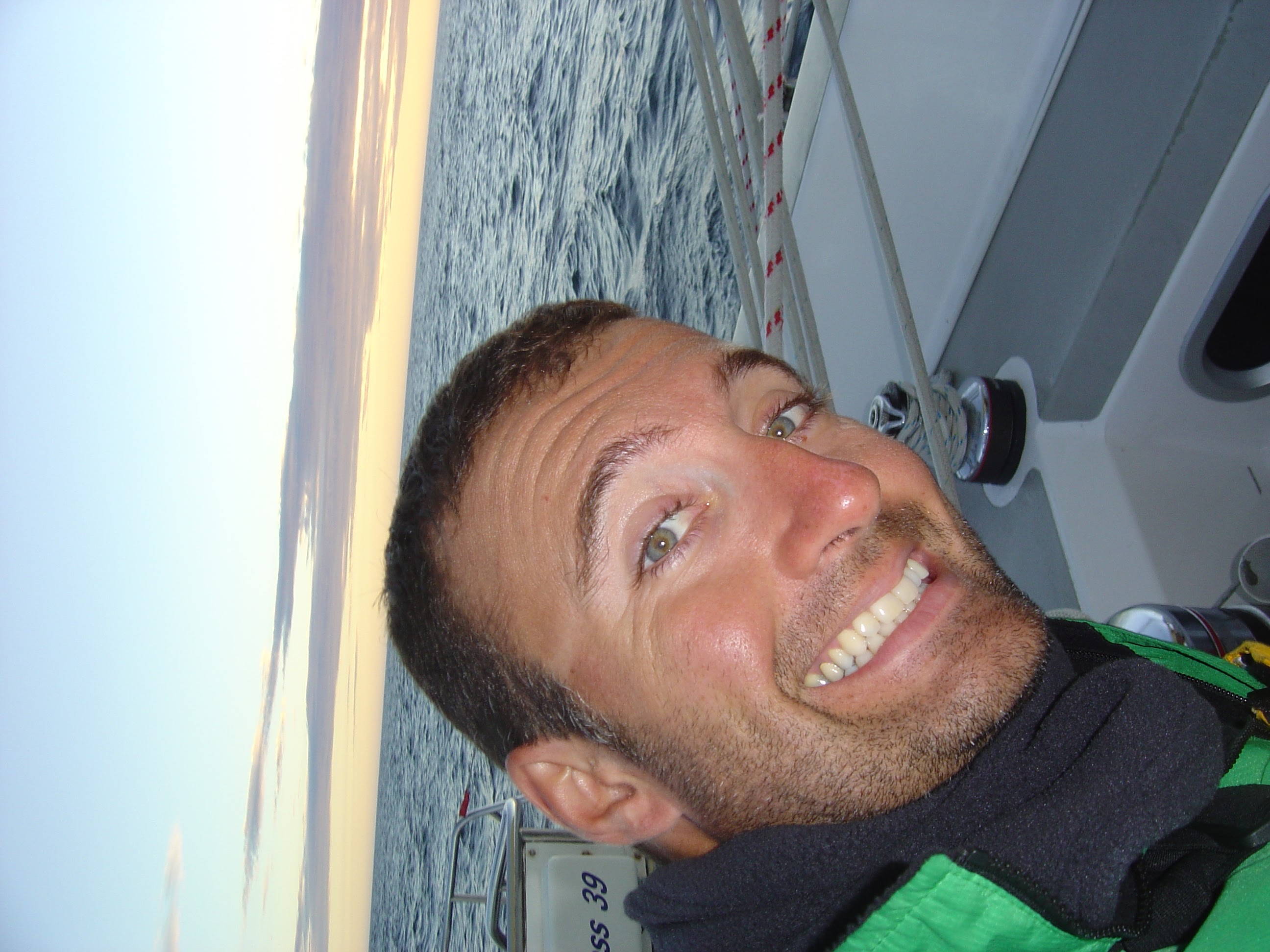
Olly Browett - Watch leader and the youngest member of the crew, he has plenty of sailing experience which makes him a natural choice to lead the watch. Helmsman and occasionally on the bow when he's not looking at the numbers.
On the Bow
John Bass (Bass to avoid confusion when the other John is on deck). I occupy the no 1 position, trim the headsails, scribble these logs and generally look after technical stuff like the e-mail system onboard.
Colin Barber (one of the BP Crew) Colin is the number two on the bow occasionally swapping with Holger. He is also our pole monkey; regularly scaling the forestay and perching at the end of the pole for spinnaker peels.
At the Helm
Holger Bindel - Medic (when you can get an appointment) Helm, main trimmer and is often seen on the bow in the no 2 position.
Rob Phillips - Helm and safety officer. Rob has many a story tell we just wish we could understand his broad Northern accent.
In the Snake Pit
Goldie Raley - Part of a crack two girl team in the 'pit' and in charge of sail repair and maintenance.
Laura Alexander - works the pit with Goldie and has clothed the team in everything we need.
At the Nav' table
Stephen Allberry - Navigator and veritable encyclopaedia of interesting facts.
John Bass




Saturday, December 4, 2004
Leg 2 Day 7 : 500 miles to Cape Horn 50°32'12.6"S 65°02'42.7"W
By the time that you read this we will be 60 miles off the Falklands and heading for the Straits of the Maire between Tierra del Fuego and Staten Island - which is a short hop, just 100 miles, from Cape Horn. If there were background music on deck right now it would probably be the very faint sound of the Jaws signature tune just over the horizon. And the tension - although masked by more than the usual dose of ribald humour (it must be something in the food) - is twofold. Firstly, we are fast approaching a key tactical moment in the leg; the Straits of the Maire form a tidal gate which could propel us away from our pursuers or rein us back as anyone in front plunges straight for the Horn and those behind make fast gains on our lead.
It all depends on when we get there... and in what order. We are currently lying third, although this is changing constantly, and of course we hope to reach the Straits with the strong tide aiding us. It will be a mountainous challenge to claw back the distance if this does not go our way, and we are doing everything in our power to give ourselves the best chance. Emotions are also bubbling away - firstly excitement - because here we are, just two days off the Cape, and this is what we came for. It looks set to live up to its cruel reputation. Put simply, we are expecting a gale late Saturday as a dress rehearsal, then a day's respite (just long enough for us to take our weekly shower and get clean for our celebration), before, right on cue, another gale hits us full in the face as we turn right at the bottom of South America. The albatross are getting bigger, we are nearly there...
The Watch
As we approach the Horn I should probably introduce those on my 'watch' - apologies for not doing this before - and I am sure that John will introduce the other half of the crew tomorrow. Our watch:
'Cop' (David Pugh) - watch leader and head helm (very dodgy Bjorn Borg hairdo right now, boat's bosun)
Chris (Christian Talpo) - No 1 at the bow, head trimmer, mainsheet apprentice (a coffee perfectionist - being Italian - and style assistant to the crew)
Rich (Richard Wardley) - No 2 at the bow, second trimmer (always but always says please and thank you! Techy expert)
Giles Mackey (BP Crew) - No 3 in bow team, snakepit apprentice (as we speak baking bread for the first time - we'll let you know how it goes)
John Stewart - No 4 in bow team, mainsheet boss (best spinnaker packer in the west, accommodation boss for port)
Major Malhi - No 5 in bow team (curry genius, best porridge award, entertainments officer)
Naomi Cudmore - snakepit boss, helm (on-board scribe, hygiene police & in charge of all cosmetic purchasing)
Jane Cook - helm, trimmer (Delia of the boat, head of all consumables, menus and snack disputes)
Andrew Smith - navigator, helm (the 'Michael Fish' of our watch)
Naomi Cudmore



Subscribe to:
Posts (Atom)


